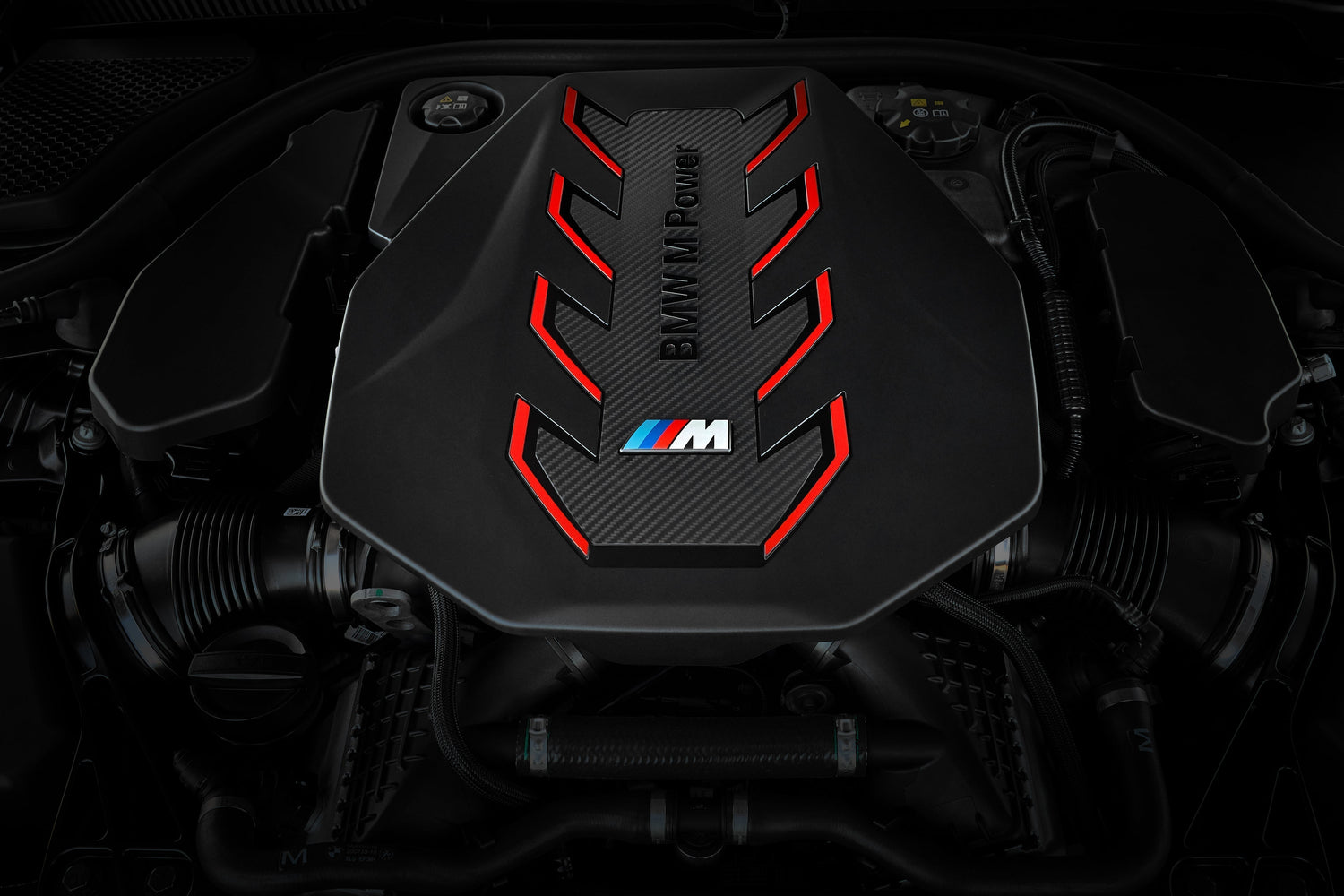
BMW’s 4.4-liter twin-turbocharged V8 has been a major part of the European performance market for nearly two decades.
The story began in 2008 with the introduction of the N63 in the BMW X6 xDrive50i. At the time, BMW described it as the world’s first production eight-cylinder gasoline engine to position its turbochargers and catalytic converters inside the V formed by the cylinder banks.

This arrangement, now commonly known as a “hot-V,” shortened the path between the exhaust ports and turbochargers, improved response, and created a more compact engine package. The design was later adopted in different forms by other manufacturers, but BMW was the first to bring it to a production V8.
Over the following years, the N63 underwent numerous revisions with four notable generations. BMW M also developed the higher-performance S63 family for vehicles including the M5, M8, X5 M, and X6 M. Ultimately, the F10 M5 received the S63TU or second generation, with the fourth and final version, the S63TU4, in the outgoing F90 M5.
The latest major evolution of that formula is the S68.
From the N63 and S63 to the S68
 The S68 reached the U.S. market for the 2023 model year in vehicles such as the BMW X7 M60i and 760i xDrive. It retained the familiar 4.4-liter hot-V, twin-turbocharged layout while introducing a new generation of engine technology designed around electrification.
Depending on the vehicle, the S68 is paired with either a 48-volt mild-hybrid system or BMW’s more powerful plug-in M Hybrid system.

That combination gives BMW considerable flexibility. Variations of the same basic engine architecture can power a luxury sedan, a three-row SUV, a full BMW M model, or a plug-in-hybrid performance vehicle producing more than 700 horsepower.
The engine, however, arrived with another major change that mattered to tuners: BMW’s newer DME9 engine control unit architecture.
S68 applications use the Bosch MG1CS221 engine control unit, built around an Infineon AURIX TC389 and TC399 microcontroller. As with many newer ECUs, factory security prevented traditional reading and writing methods from being used.
For many shops and owners, that meant conventional ECU calibration was unavailable. Early tuning options were often limited to piggyback controllers that modified selected sensor signals without providing complete access to the ECU’s calibration.
That has now changed.
Bosch MG1CS221 ECUs Are Now Supported

To protect the unlock method and reduce the risk of access being closed by a future factory update, the initial ECU unlock is being performed through AutoTuner’s mail-in service.
Ready to unlock a supported BMW ECU?
View the BMW mail-in unlock service.
The process is straightforward:
- The vehicle’s ECU is removed and sent to AutoTuner USA in Auburn, Alabama.
- AutoTuner performs the required unlock, without physical modification to the ECU.
- The unlocked ECU is returned to the customer, or tuner.
The tuner can then use the AutoTuner Tool in bench mode to read and write the ECU.
 The current protocol includes checksum correction and backup creation. The approximate read time of two minutes and 30 seconds and an approximate write time of 30 seconds makes the process extremely quick.
This gives professional calibrators direct access to a modern, high-value performance platform that had previously been difficult to support.
Which BMW Models Use the S68?
Current U.S.-market S68 applications covered by AutoTuner’s compatibility information include:
- 2023+ BMW 760i xDrive
- 2023+ BMW ALPINA XB7
- 2023+ BMW X7 M60i
- 2023+ BMW XM
- 2024+ BMW X5 M60i & M Competition
- 2024+ BMW X6 M60i & M Competition
- 2024+ BMW XM Label
- 2025+ BMW M5 Sedan & Touring
The MG1CS221 protocol also covers certain related 4.4-liter twin-turbocharged Land Rover applications, including supported versions of the 2024+ Range Rover SV, Range Rover Sport SV, and 2025+ Defender 110 OCTA.
Ready to unlock a supported BMW or Land Rover ECU?
View the BMW / Land Rover mail-in unlock service.

Factory Power Ranges From 523 to 738 Horsepower
One reason this platform is so interesting is the wide range of factory output BMW produces from it.
Representative U.S. specifications include:
- 523 hp: BMW X5 M60i, X6 M60i, and X7 M60i
- 536 hp: BMW 760i xDrive
- 617 hp: BMW X5 M Competition and X6 M Competition
- 631 hp: BMW ALPINA XB7
- 644 hp: Original BMW XM
- 717 hp: BMW M5 and M5 Touring
- 738 hp: BMW XM Label
These figures should not all be interpreted in exactly the same way.
The M60i and similar mild-hybrid vehicles use a 48-volt system that provides relatively modest electrical assistance. The M5 and XM, by comparison, are plug-in hybrids with a substantially more powerful electric motor integrated into the transmission.
BMW rates the M5’s combustion engine at 577 hp, but the complete M Hybrid system produces 717 hp. The XM Label also uses a 577-hp V8, but its combined system output reaches 738 hp.
That distinction is important when discussing tuned results. Engine output, combined hybrid-system output, wheel horsepower, and calculated crank horsepower are not interchangeable measurements.
How Much Power Can a Tuned S68 Make?

Development of the S68 aftermarket is still relatively young, but early advertised figures indicate substantial headroom.
European tuning packages are already claiming approximately 900-1000 hp and over 1,300 Nm of torque, proving the platform is extremely capable.
Those figures should be treated as examples rather than guarantees. Actual results will depend on:
- The specific S68 vehicle and factory calibration
- Fuel quality and octane
- Engine and hybrid-system temperatures
- Battery state of charge on plug-in-hybrid models
- Intake, exhaust, cooling, and other modifications
- The type of dynamometer and correction method used
- Whether output is measured at the wheels or calculated at the crank
- How far the tuner is willing to push the platform
Nevertheless, even the early results show why direct ECU access is so significant. Tuners can now begin properly developing boost control, ignition, fueling, torque management, throttle behavior, temperature protection, and other calibration areas that cannot be comprehensively addressed through a basic piggyback device.
More Power for a Much Heavier M5
 The new G90 M5 provides a useful example of why the tuning market is interested in the S68.
BMW rates the G90 M5 at 717 hp and 738 lb-ft of combined system torque. It is the most powerful production M5 yet, but its plug-in-hybrid drivetrain also contributes considerable additional mass.
BMW lists the G90 M5 at 5,390 pounds. The 2021 F90 M5 was listed at 4,345 pounds, making the newer car approximately 1,045 pounds heavier.
Additional power can help overcome some of that weight, but the future of the platform will involve more than peak dyno figures.
As S68 development matures, the aftermarket will likely focus on improved turbo inlets and intake systems, less restrictive exhaust components, additional charge-air cooling, expanded fuel-system capacity, ethanol-compatible calibrations, transmission development, and eventually upgraded turbochargers and internal engine components.
What This Means for Tuners and Owners
For professional tuners, the MG1CS221 unlock opens access to some of the newest and most valuable performance vehicles in the BMW, BMW M, ALPINA, and Land Rover markets for use with an AutoTuner Tool.
For owners, it means more complete tuning solutions can begin replacing the limited and expensive options that were previously available.
And for the broader tuning industry, it is another example of a modern ECU platform once considered inaccessible becoming available to independent calibrators through AutoTuner.
If you own an S68-powered vehicle, or tune these vehicles professionally, ask your tuner about AutoTuner support for the Bosch MG1CS221 ECU.
Ready to unlock a supported ECU?
Check Compatibility and Order Your ECU Unlock.